
A Pretendian Primer
Background on how the Hunters unilaterally decide who can be Native
This is in no way exhaustive in terms of determining Indigeneity for real because as unique cultures and sovereign Native Nations only we can determine who is or is not of us. This is just an examination of Pretendian Hunters distorted idea of belonging, metrics that they don't even meet themselves…
It's a great time to be Native, as long as you are actually Native.
We've entered into a new era of authentic Native representation unlike anything ever seen before. It was ensconced in the White House office of the first Native female cabinet member, Former Secretary of the Interior,now New Mexico Gubernatorial Candidate Deb Haaland (Laguna Pueblo),at the writing desk of 2019 Pulitzer Prize nominee author Tommy Orange (Cheyenne and Arapaho), gliding down the catwalk of fashion week with model/actress/activist Quannah ChasingHorse (Hän Gwich'in/Sicangu-Oglala Lakota),and riding in a stolen truck full of Flaming Flamers down the dusty back roads of the fictional town of Okern, Oklahoma in Writer/Director Sterlin Harjo’s (Seminole/Mvskoke) television show Reservation Dogs.
Gone are the slur that was the Washington Commanders former name and the stereotypical mascot Chief Wahoo, the former Cleveland Guardians name that borne him following suit as well. We've gone from Peter Pan's Tiger Lily to Oscar Nominee and Golden Globe winner Lily Gladstone (Siksikaitsitapi/Nimíipuu). It's truly incredible.
It's also not enough.
For all that successful representation there's a longtime issue threatening Native Peoples only now gaining a foothold in the media: the phenomena of the “Pretendian.”
Before I give a very long, very detailed, and absolutely gross explanation of who a Pretendian is it's important to note who a Pretendian *isn't*.
There exists in Indian Country a group of people who never had a chance to live in their culture/s. They are what is called “reconnecting". Pretendians are different from reconnecting Natives, those scattered across the diaspora, detribalized by the reeducation camps (federal Indian boarding “schools”) where our Native youth were kidnapped and held hostage, their hair forcibly cut and their language/s, culture/s, and connection to family and community beaten out of them, sometimes until they died, The 60s-70s Bureau of Indian Affairs Relocation Program in which Natives were removed (again) from their reservations and deposited in urban areas, left to sink or swim on their own, and a myriad of other assimilationist policies put into place to dwindle our numbers via cultural genocide since physical genocide had failed. Reconnecting Natives have roots in community that they have not yet been called home to tend.
As for Pretendians the most commonly accepted definition of a Pretendian is a person who claims Native heritage or identity while having none at all. Different from people who reply “I'm part Native myself" when introduced to a claimed Native citizen Pretendians fraudulently make being Native their central identity, not just utilizing whatever culture/s they've “discovered" (because the pioneering spirit embodied in “american exceptionalism” never steals anything, not with the divine right of manifest destiny blessing them at birth with a “get out of hell free" card) but ensuring their destruction along the way. They're the Dust Bowl of community, destroying everything in their wake, including the roots of those reconnecting who are now seen with suspicion through no fault of their own. That fault lies clearly at the feet of the Pretendian.
Their faux identity, more often than not, is a recent discovery. They either become whatever 23 and Me says they are due to their scintilla of Indigeneity or, worse, embrace being Native because of vague family stories about "hiding” instead of enrolling and their grandma's high cheekbones, acting on the incredibly misplaced hubris instilled in them from growing up in a society that let them believe that in everything they do they earned a home run when in actuality they'd been born on third base.
Pretendians cherry pick what they like from our unique cultures and claim (mostly) Cherokee because that's the Native Nation that they learned about in that paragraph describing the Trail of Tears in a history book in 4th grade, an act that not only has far reaching and cataclysmic consequences for Native cultures, sovereignty, and governments but gives them an advantage over Natives in white spaces due to their unscrupulous extraction.
Having been raised in that white space which encompasses most of the world they understand how to navigate a colonial system set up for those of the global majority to fail. This in turn allows them access by a society who accepts them at face value into spaces they wouldn't, and shouldn't, otherwise occupy.
Pretendians head up Native Studies Departments at universities, ensuring that false ideas of who Natives are continue to be perpetuated. They create legislation based on their views of what's best rather than listening to and serving real Native communities. They are given Native scholarships and grants, denying opportunities to Natives whose chances at them are already small enough.
This is not a new issue for Natives. We watched as Iron Eyes Cody, in actuality Sicilian actor Espera Oscar de Corti, cried his way into everyone's collective consciousness, affirming our place as relics of a past we did not help write and whose veracity, much like Cody's claims of Cherokee, Cree, and various other Native heritage, isn't what it claims to be.
Having Native identity even partially defined by those that claim Native when they aren't results in continued erasure and ingrained societal stereotypes of Natives, further dehumanization for Peoples who still struggle to be heard.
Since Pretendians have no connection to Native communities they have no real stake in how this affects our collective communities, causing harm from which they will feel no consequence. The only people that benefit from this form of redface is the Prendians themselves.
While most Natives agree that it's a problem that needs to be handled there's no consensus on just how to accomplish that.
One of the problems with identifying Pretendians, whose personalities are generally a pan Indian muddling gleefully perpetuated by those “playing Indian”, is that non Natives have a skewed or, at times, outright false understanding of what it means to be Native. Because of this it doesn't register on a wide scale just how harmful this practice is, resulting in little, if any, consequences for this fraud, as seen with Andrea Smith.
Even when outed Pretendians more often than not continue playing Indian. They are the victim, crying racism and doubling down on their dubious or non-existent connection. They weaponize their tears in the way white women are so very comfortable doing because it tends to get them their way. Society almost always chooses to support the Pretendian, a continuation of Native silencing and erasure. Everyone wants to be us but no one wants to believe us.
The issue is a real concern for Indian Country and needs to be addressed in order to ensure authentic representation, protection of our unique Native cultures, and to maintain our inherent tribal sovereignty and self determination.
The tide is starting to turn however. Mainstream media has finally seized on this concern due largely to the allegation that Sacheen Littlefeather, the self identified White Turtle Mountain and Yaqui actress/activist who refused Marlon Brando's Oscar for The Godfather in 1973, was not actually Native (more on that in another post).
At the forefront of these revelations is Jacqueline Keeler, a Diné/Yanktonai writer who is a published author, journalist, and creator of the Alleged Pretendian List.
Jacqueline Keeler is a well known, if controversial, figure in Indian Country. A Dartmouth graduate, she has written for Indian Country Today (now ICT), The Daily Beast, and the San Francisco Chronicle. She authored the book Standoff: Standing Rock, the Bundy Movement, and the American Story of Sacred Lands and once sat on the board of The Native American Journalists Association, now known as The Indigenous Journalists Association.
In the mid 2000s she cofounded Eradicating Offensive Native Mascotry (EONM), an alliance of Native advocates and allies who worked to address issues of racism regarding Native sports mascots and other forms of misrepresentation and cultural appropriation. It was their collective work that brought the mascot issue to the forefront and, along with the BLM uprising and racial reckoning in 2020, resulted in The Washington football team and Cleveland baseball team changing their names.
In an effort to stem the tide of these “Indiain’ts” Keeler released the "Alleged Pretendians List" in 2021, a compilation of 195 people suspected of faking Native identity. The list was not completely verified at that point and, despite Keeler's assertions that it would be released publicly with incontrovertible data it has trickled out piecemeal, though the entire list minus all the evidence was available on a Google sheet, or, if you believe Jacqueline’s claim on the main page of her site, it was never published publicly at all.
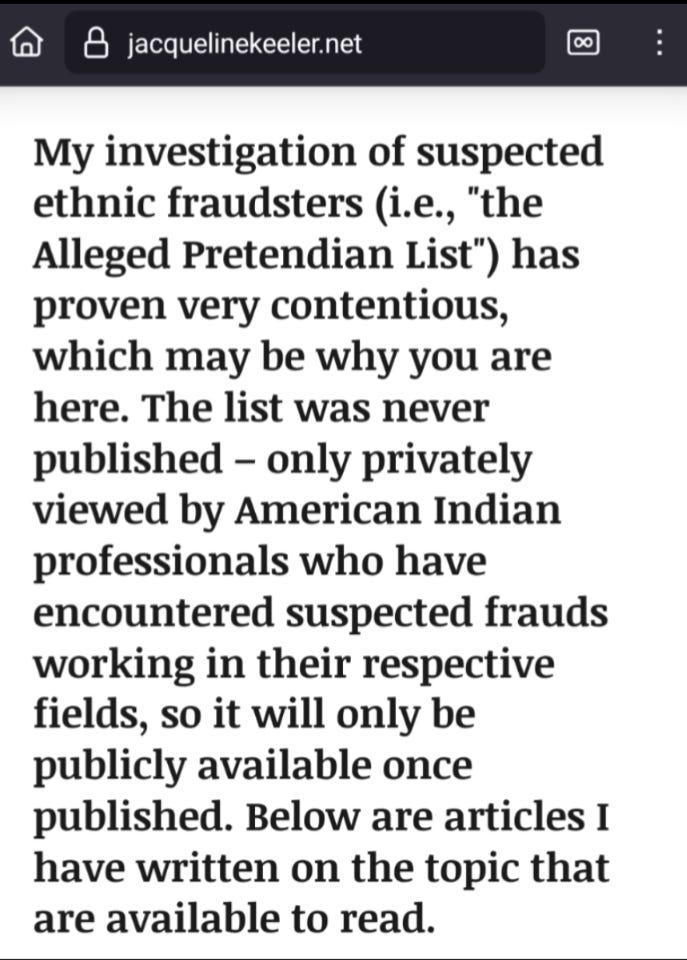
Photo from the main page of JacquelineKeeler.net where Jacqueline claims the Alleged Pretendians List was never published.
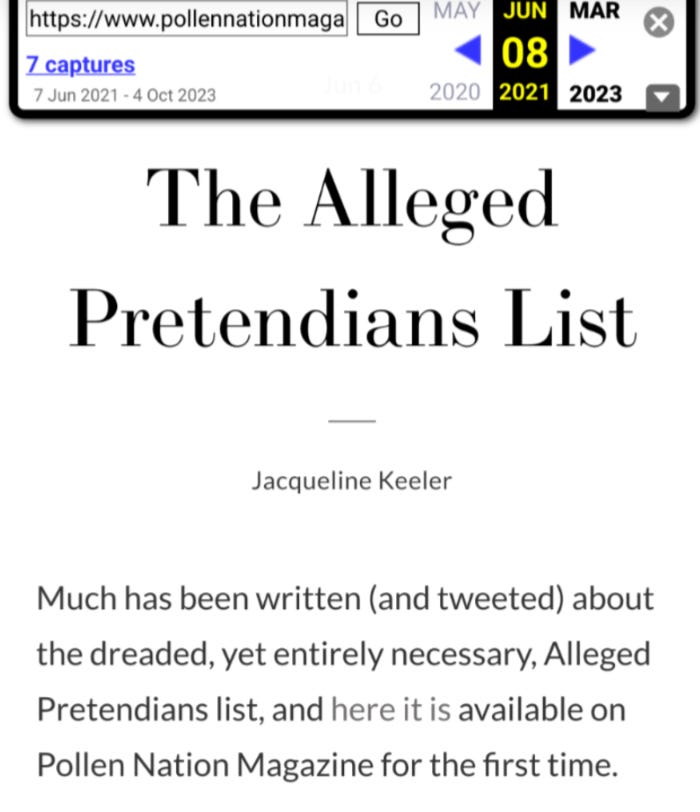
Here's where the list was published by Jacqueline Keeler in 2021.
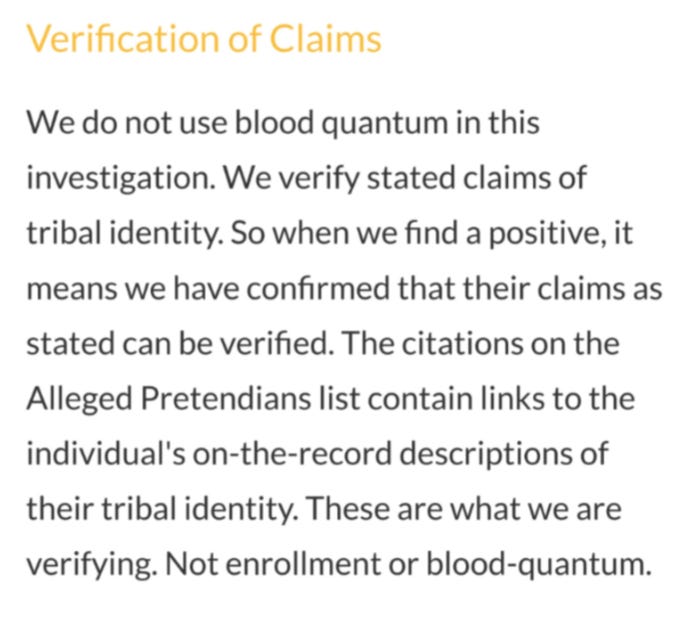
Keeler maintained the list would only verify listees "stated claims" of tribal identity. Those on the list were supposedly self identifying public facing persons falsely claiming Native heritage or identity and monetizing those fraudulent claims. As for criteria Keeler noted she would not use blood quantum, a fractionated measure of the amount of Native blood one possesses based on individual and group ancestry which, in reality, is nothing more than a government construct meant to “piece" Natives out of existence, or enrollment, citizenship granted by a federally recognized Native Nation that is a political status, as the standard as to false claims of Native identity.
There are varying opinions on the effectiveness of the list. Some champion it and Keeler for having the bravery to take the initiative in dealing with Pretendians, while others question it (and Keeler's) credibility.
Due to concerns about lack of transparency in methodology as well as errors in documentation for accusations made publicly about people both on and not on the list questions have arisen as to reliability and impartiality.
Full disclosure: I initially supported the list. I supported it for far longer than I should have. I 100% agree that Pretendians are a pressing issue that threaten Native Nations and Peoples. I believed this list was an excellent tool for protecting community and sovereignty. It was only when it was released and allegations of anti Blackness surfaced that I began to question it. After consulting with my Elders I emailed Keeler and asked her to take a beat so Indian Country's feedback and concerns could be addressed. She in turn publicly released the email and turned it into PR.
My response was to publicly denounce the list and apologize for my role in the harm caused. Keeler immediately blocked me on social media, a retaliatory act that didn't last long. You can't keep tabs on someone you can't watch.
Since that time I have been critical of the list and Keeler. While always based in fact, vetted and sourced, those criticisms have not always been as gracious as they could have been. I own the fact that I nicknamed her Poison Pendian Attackqueline Keeler. While funny in that Native way I understand that this will raise questions as to my ability to research and present this piece without bias. That's completely understandable. I make no apologies for my tone or using my authentic voice while in the trenches however. All I can say to that is that I have reached out to as many people in community as possible for comment and confirmation, both supporters and opponents of the list. That includes Jacqueline Keeler, The Tribal Alliance Against Frauds, The San Francisco Chronicle, amongst others. To tell this story correctly all points of view must be included, despite my personal feelings on the matter.
I have not vetted every investigation on the Alleged Pretendians List. I readily admit that there are entries that are verifiably incorrect. That does not mean the entire work is without fault, nor that it is above question. In order to ensure accuracy and that the work that's being done meets its own stated claims of protecting Native Nations and Peoples any questions about its methodology, potential bias, and conclusions must be taken seriously and addressed.
More often than not those questions have not been addressed. Keeler and her associates, many of whom were not named publicly for months and sometimes years, fiercely defend their work. They don't rely on facts however.
Instead Natives that speak up are called “Defendians," accused of defending Pretendians for personal gain with no supporting evidence that this characterization is true. To ask questions is to risk being brought under the microscope yourself, with informal investigations into the background of those seeking clarification, release of personal information not germane to the issue, or repeated insinuations of wrongdoing or personal failings that can go on for years. If you're white your input is not wanted or needed, a stance that's just about the only thing Natives agree on about the list. It's a standard Keeler ignores when it serves her agenda.
Documentation that the list may be wrong is often ignored and given no response. There is no room for legitimate critique when it comes to Keeler, whose penchant for deleting social media posts to avoid accountability and blocking those who question her work, is a running joke on X (formerly #NativeTwitter). Keeler even has replies limited on her X account, with only those she mentions or follows able to comment, an effort to control the narrative, silence critics, and avoid responsibility.
It's not support for Pretendians as Keeler alleges that causes people to ask for more information, clarification, or correction. That should be expected of any investigation by a journalist. It's her behavior and secrecy that taints the list.
While proclaiming to work towards advancing understanding and acknowledgement of who Natives truly are and protecting the cultures and rights afforded Natives the list has instead become the springboard for the invalidation of Native descendants, disregard of traditional kinship ways, and attacks on individual Nations sovereignty by Keeler and her associates, such as The Tribal Alliance Against Frauds.
Keeler uses a scatter shot methodology that changes depending on whom she's investigating and is at times a standard even she cannot meet. The lack of rigorous and equitable standards means her conclusions can be faulty. This is concerning as she's currently being platformed as an expert on Pretendians and Native identity by news outlets such as San Francisco Chronicle and The New York Post, a dangerous situation when mistaken allegations that Keeler has a history of refusing to acknowledge or correct are accepted as fact.
According to Keeler Native identity is a political status, not a racial one, which is why she only focuses on people claiming Native identity in the so called united states except when they will raise her profile as with Buffy Ste Marie (more on that later).
As for Keeler's definition of Native identity, she's not wrong but she's not right either.
Natives are not a race. We weren't racialized into a monolith until invasion. Instead we are who we have always been: sovereign nations and their Peoples. It's an important distinction as it respects our sovereign governments that have been here since time immemorial.
For some Native Nations, though not all, the US acknowledges that political status, federally recognizing our governments and entering into treaties that are the "supreme law of the land", per Article VI of the Constitution. In recognizing that status they've christened Native citizens "American Indians", a monolithic label that homogenizes us into a single entity, removing our individual sovereignty even as it purports to respect it.
This political status is reserved for citizens of federally recognized Native Nations, those enrolled in their tribes, 574 American Indian tribes and Alaska Native entities in all.
This status does not apply to state recognized tribes, though some federally recognized Nations are also state recognized, or unrecognized tribes, both of whom may have applied for and are waiting a determination of federal recognition. It definitely doesn't apply to fake tribes, which are usually 501(c)3 nonprofit corporations who are not Native ancestrally or culturally, though some are state recognized anyway.
If this seems confusing that's because it is. There are so many regulations and nuances when it comes to Native identity that unless you're an expert on every individual Nations laws and kinship, federal Indian law, or have lived experience in a specific Native community chances are you're going to get it wrong.
Each federally recognized Native Nation has its own government, culture, and kinship ways. They also have different requirements for citizenship unique to their Nations, a recognition of their inherent sovereignty. Native Nations, and only Native Nations, can determine who is a citizen. To attempt to define who is Native without respect to the determination of that specific Nation is an attack on sovereignty, calling into question the Nations ability to govern themselves. Citizenship in a federally recognized Native Nation is an absolute. If you're a citizen you're a citizen.
That hasn't stopped Keeler from questioning it anyway.
Up Next: Jacqueline Keeler proclaims that a federally recognized Native Nation is a “white tribe"…
Thank you for sharing your thoughts! As always, I appreciate the work you are doing, especially in these challenging times. I do have a genuine question- in your work above, you distinguish state tribes from 501 (c) (3)'s. You insinuate there are perhaps some instances of blurred lines-how do you (yourself) distinguish the two? For context, I am enrolled in a state-recognized tribe (in one of the more controversial states) and am always curious (for lack of a better word) about the perspectives those in this line of work have regarding our communities.
Thanks for taking the time to read this!
Jacqueline Keeler blocked me too
hehehe